
The ironies of automation: why the human above the agent matters more
Dr. Aaron Hutzler · 15 August 2026 · 6 min
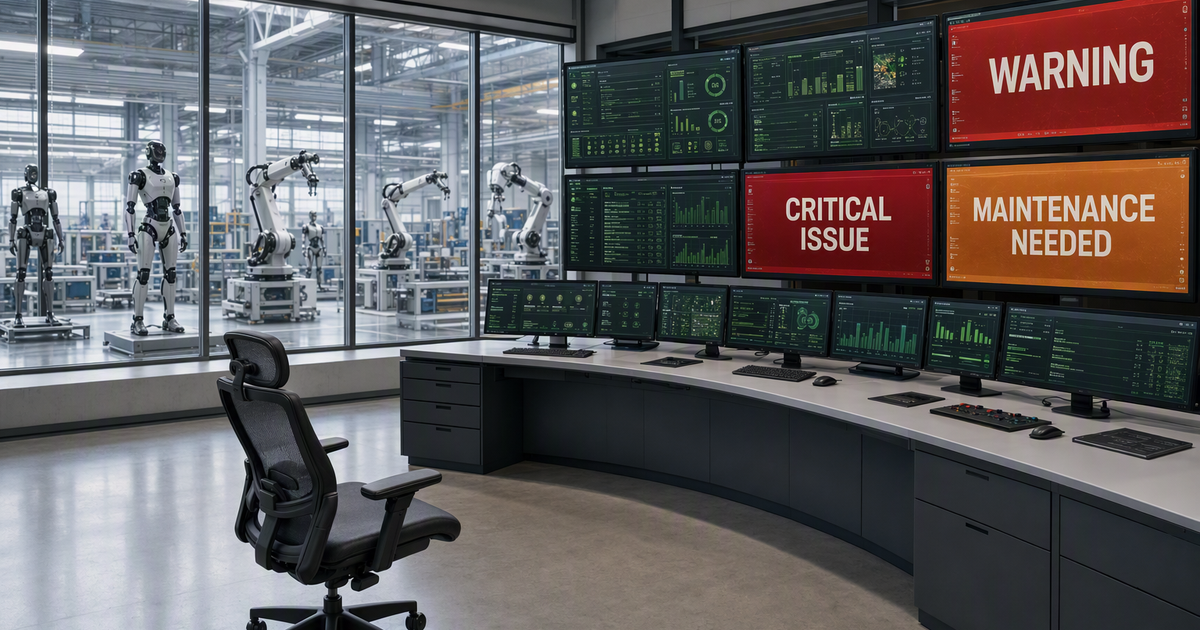
In 1983 the cognitive psychologist Lisanne Bainbridge published a five-page essay that still shapes automation research today: "Ironies of Automation" [1]. She studied control rooms in power plants and process industries, places where machines had taken over the work and people were left to supervise. Her finding: Automation does not remove the human from the system. It makes the human's role harder and more important at the same time. Whoever runs a coding today sits in exactly that control room.
1. Four ironies, one control room
The leftover tasks. The designer automates whatever can be automated. The human keeps the rest. That rest is exactly the set of tasks the machine could not handle. The easy work leaves, the hard work stays.
The loss of practice. Skills wither without use. The operator who has not steered by hand for years is expected to steer best in the emergency, with less practice than ever.
The sustained attention. Humans lack the patience to watch for rare events. Bainbridge cites the vigilance research: After about half an hour, attention to a display where little happens measurably drops [1]. Of all tasks, supervision, the one that remains, is the one humans are built for worst.
The contradiction in the foundation. The plant was automated because the human counted as the source of error. In the emergency the same human is expected to step in and do what the automation could not. Whoever distrusts the human ends up relying on them twice.
2. The developer is now the control-room operator
All four ironies translate to the work with a coding agent without remainder. Research has caught up: Forty years after Bainbridge, Mica Endsley extended the ironies to AI systems. The more capable the AI and the more natural its dialogue, the harder it becomes for people to judge its limits and its reliability [2]. A group around Auste Simkute found the ironies again in generative AI: The user's role shifts from producing to evaluating. Automation makes easy tasks easier and hard tasks harder [3].
The leftover tasks: The agent finishes the routine change in minutes. What lands with the human is what the agent could not do. That is the tangled edge case, the architecture question, the incident at the worst hour.
The loss of practice: Whoever has written little code of their own for months reads foreign code worse. The skill is needed exactly in the moment the agent fails. And then under pressure. A survey of 319 knowledge workers shows how it starts: The more people trust the AI, the less critical checking they report of their own [4].
The sustained attention: The human is asked to read foreign code line by line, code in which almost everything is correct. That is the vigilance task from the control room, just with more lines. We measured how weak even a machine checker gets when nobody checks it: A checker that looked reliable picked the first-shown option in 32 of 36 verdicts [5]. No attentive reader caught that. A measuring procedure did, one that put the checker itself on the test stand.
The contradiction in the foundation: The agent is in the house because humans write slowly and make mistakes while doing it. The result is still signed off by a human. And by one who never held the code in their head, because that moment never existed. How that goes has been measured: With an AI assistant, participants in one study wrote less secure code than the control group and were more often convinced it was secure [6]. The sense of time deceives too: In a randomized trial with experienced developers, the AI tooling made the work 19 percent slower on average. The participants estimated afterwards that it had made them 20 percent faster [7].
3. What spec coding draws from this
Bainbridge did not only describe the ironies, she named the direction of the remedy: If supervising is the new work, the plant must be built for the supervisor, not only for the process. Four consequences:
- Verification tooling for the human, not only for the machine. Whoever introduces agents and saves on the reviewer's tooling buys only the cheap half of the automation. The human gets no raw but condensed findings: what was checked, what stood out, what stays open.
- Replace sustained attention instead of demanding it. Machine checks take over the line-by-line watch; they do not tire. The human judges at named points. Those are the points about intent rather than form.
- Preserve the practice. Small slices instead of one final acceptance: Whoever accepts every slice stays inside the material and can intervene while the mistake is still small. Every line has a named human reviewer.
- Check the checkers. The measuring instrument stands on the test stand before its verdict counts: known-wrong inputs first. Our own check caught 12 of 12 [5]. So the human checks the checkers instead of every raw diff. The vigilance sits where it does not tire.
4. An honest limit
Bainbridge found the ironies in people in front of control panels. Their transfer to the work above a coding agent is backed by our own measurements where cited and stays observation elsewhere. And no tooling lifts the fourth irony: In the end a human answers for what they did not write. The tools can help carry that load. They cannot take it away.
5. Conclusion: the expensive half
The agent is the cheap half of the automation. The expensive half is the workplace of the human sitting above it. That is exactly the half most often forgotten at purchase.
Automation does not remove the human. It makes the human the most important checkpoint in the system. Equip that checkpoint accordingly.
6. Sources
[1] L. Bainbridge, "Ironies of Automation", Automatica, vol. 19, no. 6, 1983, pp. 775-779.
[2] M. R. Endsley, "Ironies of artificial intelligence", Ergonomics, vol. 66, no. 11, 2023, pp. 1656-1668.
[3] A. Simkute, L. Tankelevitch, V. Kewenig, A. E. Scott, A. Sellen and S. Rintel, "Ironies of Generative AI: Understanding and Mitigating Productivity Loss in Human-AI Interaction", International Journal of Human-Computer Interaction, vol. 41, no. 5, 2025, pp. 2898-2919.
[4] H.-P. Lee, A. Sarkar, L. Tankelevitch, I. Drosos, S. Rintel, R. Banks and N. Wilson, "The Impact of Generative AI on Critical Thinking: Self-Reported Reductions in Cognitive Effort and Confidence Effects From a Survey of Knowledge Workers", CHI, 2025.
[5] Betteryields, "Manufacturing discipline, not engineering", 2026, internal piece (Beitrag 0004), MSA chapter with the measurements from the pilot scale.
[6] N. Perry, M. Srivastava, D. Kumar and D. Boneh, "Do Users Write More Insecure Code with AI Assistants?", ACM CCS, 2023.
[7] J. Becker, N. Rush, E. Barnes and D. Rein, "Measuring the Impact of Early-2025 AI on Experienced Developer Productivity", arXiv:2507.09089, 2025.